
Hebcal 2025 Year in Review

We’ve been hard at work this past year making Hebcal easier to use and a more complete resource. Here is a summary of the changes we’ve made (major and minor) during the past Gregorian year.

Fully Hebrew calendars

Major contribution by Doron Behar

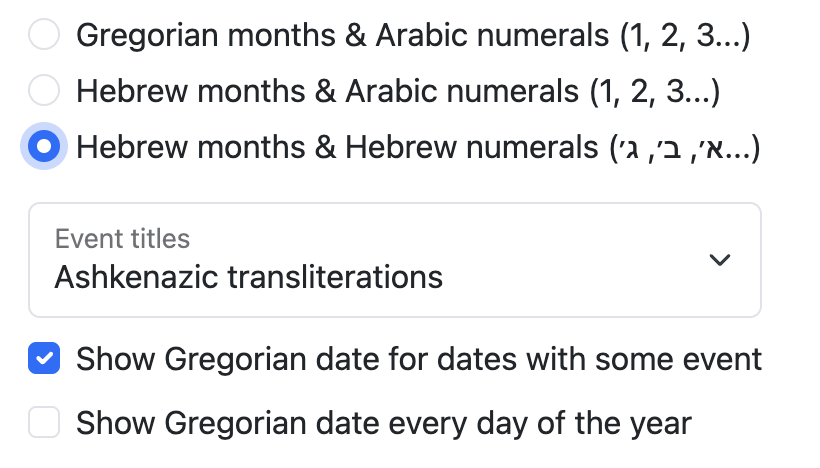
In December 2025, Hebcal added support for fully Hebrew calendars, introducing a fundamentally different calendar model from the traditional Gregorian-first layout. Instead of presenting Gregorian months with Hebrew dates as annotations, this new mode uses Hebrew months as the primary structure, with Gregorian dates shown as secondary, auxiliary information.

This inversion more closely reflects how the Hebrew calendar is traditionally experienced, making Hebrew months, holidays, and week structures first-class elements rather than overlays. Printable full-year PDF output is also supported.

You’ll find the new options on our custom Jewish calendar page:
Holidays

We corrected Sigd date handling when 29 Cheshvan falls on Shabbat. Sigd is normally observed on 29 Cheshvan, but when that date coincides with Shabbat (as in Hebrew year 5785), the holiday is observed earlier, on Thursday, in accordance with Israeli law. This matches actual practice, as reported in contemporary coverage such as the Jerusalem Post.

Torah Readings

We added the Megillah reading for the morning of Tisha B’Av, corrected Ashkenazic transliteration for Shabbat Chol ha-Moed Sukkot, fixed the Hebrew spelling of Korach with niqqud (קֹרַח) and without (קורח). Aliyah divisions for Parashat Terumah now align with Koren, Etz Hayyim, and the USCJ Luach.

The Parsha Year page is now easier to read on both mobile devices and large screens.

Daily Learning calendars

We added four new study cycles added to the existing suite of perpetual learning calendars:

Perek Yomi introduces an alternate option for Mishnah study: one full chapter per day. This complements the already-available Mishna Yomi calendar (two mishnayot per day) by offering a faster, chapter-based rhythm that completes the Mishnah on a shorter cycle. The Mishnah, redacted around 200 CE, is the foundational text of the Oral Torah and the basis for later Talmudic discussion.

Daily Rambam (Maimonides’ Mishneh Torah) now includes support for the traditional three-chapters-per-day track, in addition to the existing one-chapter-per-day option.

Sefer HaMitzvos Yomi adds a daily study calendar for Rambam’s enumeration of the 613 commandments. This cycle focuses on one or more mitzvot each day, offering a thematic alternative to chapter-based halachic study. The cycle takes just under one year to complete.

Kitzur Shulchan Aruch Yomi provides a daily learning cycle for Rabbi Shlomo Ganzfried’s concise halachic compendium, covering practical Jewish law for everyday life. The yomi schedule allows learners to complete the work over the course of one Hebrew year.

Developer web APIs

We have added experimental support for the new Model Context Protocol (MCP) standard to enable AI models such as Claude, ChatGPT and Gemini to access and interact with more precise Hebrew calendar and Jewish holidays instead of relying on built-in “knowledge”. Supported Hebcal MCP methods include bidirectional conversion between Gregorian and Hebrew dates, Yahrzeit calculation, weekly Torah portion lookup, Jewish holiday listings for an entire civil year, and daily learning schedules such as Daf Yomi. Hebcal’s remote MCP server URL is available at https://www.hebcal.com/mcp

Assur Melacha (work forbidden) API: Hebcal.com now offers an experimental REST API for determining for a given location if the date and time has a melacha (work) prohibition. This API can be used by home automation systems or other applications that wish to change functionality when Shabbat or yontiff begins or ends.

The Yahrzeit + Anniversary REST API now supports Hebrew dates as an alternative to Gregorian dates, e.g. &hyX=5769&hmX=Cheshvan&hdX=15. Hebrew month names may be specified in Hebrew (UTF-8) or transliterated using the same technique as on the Hebrew Date Converter REST API.

Localization

We added Portuguese translations, courtesy Zushe Ledovitch.

The Jewish calendar REST API now supports Hebrew memo. These translations were AI-assisted and may need some edits.

Miscellaneous / UI and usability

Molad announcements were shortened and clarified (from “Molad Sivan: Fri, 35 minutes and 10 chalakim after 3:00pm” to “Molad Sivan: Friday, 3:35pm and 10 chalakim“). Shabbat Mevarchim pages now display Molad times.

We added CSV download support for Shabbat Candle-lighting times (year-at-a-glance / “Refrigerator times”).

When selecting a city for candle-lighting and fast times, our typeahead search now includes a clear (×) button.

iCalendar feeds now include the newer REFRESH-INTERVAL and improve compatibility by fixing default to be P7D.

To reduce server load of spiders/robots indexing extreme past (Gregorian year 100 or earlier) and far-future years (Gregorian year 3000 or later), the website no longer publishes detailed holiday or Torah reading pages. Converting between Hebrew and Gregorian dates for very early years is mathematically possible (and still supported by our Hebrew Date Converter), but the results should be treated as approximations rather than historically precise dates. See Hebrew and Gregorian date conversion accuracy for more details.

Following modern HTTP semantics, we transitioned broadly to ETag-based caching, removing Last-Modified headers. This improves CDN behavior and client cache correctness.
Yahrzeit calendar search

Hebcal’s Yahrzeit + Anniversary calendar lets you create a personal list of Yahrzeit (memorial) and Yizkor dates, Hebrew Birthdays and Anniversaries for 20+ years. Once your personal list has been created, you can subscribe to free annual email reminders & calendar downloads to Apple, Google, Outlook, and more.

To keep things simple, Hebcal does not require any user registration or login. After creating your calendar, you may optionally sign up to receive annual reminder emails (sent one week before and one day before each anniversary).

If you have signed up for annual email reminders and would like to view or make changes to an existing calendar, the easiest way to find your calendar is by searching for an existing Yahrzeit + Anniversary Calendar by email address. If your email address is found, a confirmation email message will be sent to your email address containing personal calendar link(s). Click the link(s) within that message to view your personal calendars.

Tanakh Yomi / תנ״ך יומי

From ancient biblical times, the Torah has been divided into portions which are read each week on a yearly calendar. In line with this tradition, various calendars have emerged to facilitate groups of learners in collectively studying designated texts.

Tanakh Yomi is a daily learning cycle for completing Tanakh annually. On weekdays, 293 chapters of Prophets (Nevi’im) and Writings (Ketuvim) are recited according to the ancient Masoretic division of sedarim. On Shabbat, each Torah portion is recited.

In addition to Shabbat, the Tanakh Yomi calendar also skips major holidays (Pesach days 1 and 7, Shavuot, Rosh Hashana , Yom Kippur, Sukkot day 1, Shmini Atzeret), Purim, Yom HaAtzma’ut, and Tish’a B’Av.

The Tanakh Yomi cycle completes each year and restarts the day after Shmini Atzeret. The cycle follows the Israeli schedule in the sense that it does not make any special accommodations for yom tov sheini. The Hebcal implementation was created after careful study of the schedule posted at דף הבית | תנ״ך יומי website.

You’ll find Tanakh Yomi on our Daily Learning pages and also on the Downloads page.

5783 Year in Review

Shana Tova! We wish you a happy and healthy New Year. Rosh Hashana 5784 begins at sundown on Friday, September 15.

Here is a summary of some changes we’ve made to Hebcal (major and minor) during the past Hebrew year (5783).

Holidays

Added Chag HaBanot / חַג הַבָּנוֹת, a North African Jewish women’s holiday occurring on the 1st day of Rosh Chodesh Tevet.

Added five modern Israeli holidays recognized by the Knesset (Family Day, Yitzhak Rabin Memorial Day, Ben-Gurion Day, Herzl Day, Jabotinsky Day).

Added infrequent holidays Purim Meshulash and Birkat HaChama (previously announced in Tishrei 5783 updates).

Shabbat & holiday candle-lighting times

Default candle-lighting offset for Haifa and Zichron Yaakov is 30 minutes.

We added an Zmanim (halachic times) iCalendar feed for Apple, Google, Microsoft Outlook and any calendar app that supports the iCalendar (.ICS file extension) standard.

Hebrew Date Converter

Improved support for dates before the Common Era (B.C.E.), for example Gregorian year 0 is now interpreted as 1 BCE. Warning! Results for year 1752 C.E. and earlier may be inaccurate. Hebcal does not take into account a correction of ten days that was introduced by Pope Gregory XIII known as the Gregorian Reformation. [1]

On devices with a keyboard, Hebrew Date Converter can be navigated using left-arrow and right-arrow keyboard shortcuts to decrement and increment by a single day.

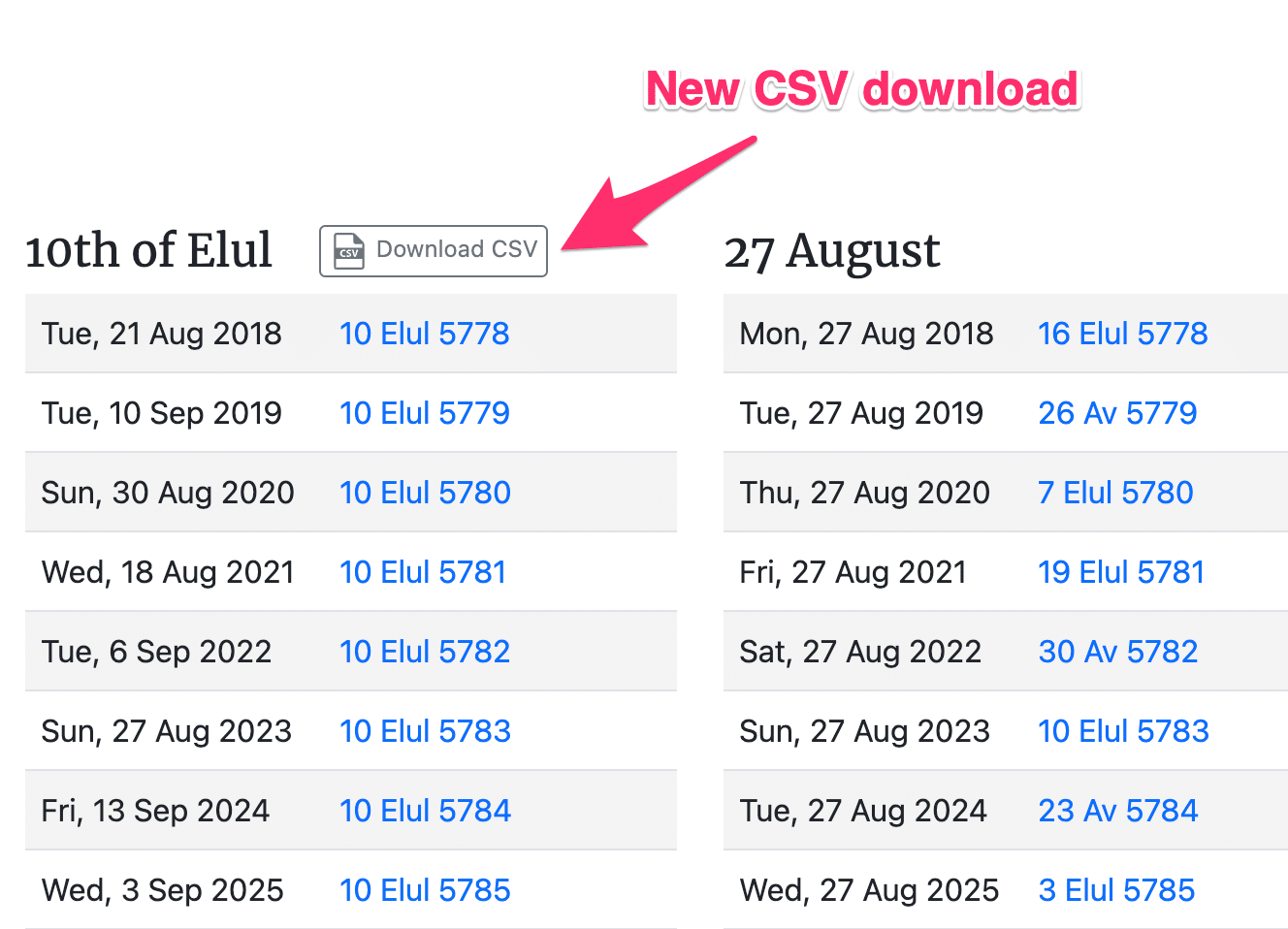
In addition to converting a single date, the Hebrew Date Converter now displays tables of dates 50 years into the future (in both Gregorian and Hebrew flavors). Hebrew dates can be downloaded as an 80-year CSV file.

Yahrzeits, Birthdays and Anniversaries

Added a Bulk Upload / Import for Yahrzeit + Anniversary calendar using CSV files.

Yahrzeit calendar reminders to light a candle are now the day before at 4:30pm local time (or 8pm on Saturday night).

Added a new personal anniversary calendar event type “Other” which follows the “birthday” rules and displays the event name without a yearly anniversary number (such as “Example Text” instead of “Example Text’s 53rd Hebrew Anniversary”)

Daily Learning

We’ve added several new daily (and weekly) learning calendars to study traditional texts. These include:

  • Nach Yomi – daily regimen of learning the books of Nevi’im (Prophets) and Ketuvim (Writings)
  • Yerushalmi Yomi (Jeruslem Talmud) – daily regimen of learning the Jerusalem Talmud. Using the Vilna edition, the Yerushalmi Daf Yomi program takes 4¼ years to complete. The Schottenstein edition of Yerushalmi Daf Yomi uses different page numbers than the Vilna and takes 5¾ years to complete
  • Rambam (Mishneh Torah) – daily learning program that divides Maimonides’ Mishneh Torah legal code into daily units (one chapter per day), to complete the whole work in three years
  • Tehillim (Psalms) – daily study of a few chapters from the 150-chapter book of Psalms (Tehillim)
  • Sefer Chofetz Chaim and Shemirat HaLashon – Daily study of two texts the Sefer Chofetz Chaim, which deal with the Jewish ethics and laws of speech
  • Daf-a-Week (Daf Shvuii) – learning program that covers a page of the Babylonian Talmud a week. By going at a slower pace, it facilitates greater mastery and retention

Torah Readings

Ashkenaz transliteration of תַזְרִיעַ as Tazria (not Sazria)

Added a Masorti triennial Torah Reading schedule for Israel. Although there is no formally specified triennial cycle for the Masorti movement in Israel, Hebcal began publishing a draft schedule in May 2023.

Leyning Errata

When Parashat Re’eh is read on Erev Rosh Chodesh, read the regular 3rd Haftarah of consolation (not special Haftarah for Machar Chodesh)

When Parashat Ki Teitzei occurs on 14 Elul (i.e. the preceding Parashat Re’eh occurred 2 weeks prior on Shabbat Rosh Chodesh), we read extra both the 5th and 3rd Haftarah of consolation.

Because Shabbat Re’eh was Rosh Ḥodesh, the usual 3rd haftarah of consolation was not read. Chant the haftarah of Ki tetse and then the haftarah of Re’eh as a single haftarah. In the book of Isaiah these two brief passages are adjacent

Source: Luaḥ Hashanah, Rabbi Miles B. Cohen and Leslie Rubin

Ta’anit Bekhorim (Nisan 14) is a private fast day, not a public fast day. So the Exod. 32:11-14, 34:1-10 reading for public fast days is not read on that day — not at Shaharit and not at Minhah.

Display the correct leyning for Pesach Chol ha-Moed Day 2 on Sunday

Only display 3 (not 5) aliyot on Erev Simchat Torah

Miscellaneous

Support Dark Mode (white text on a black background) for a better viewing experience in low-light environments

Vulnerability Acknowledgements for Hebcal online services

Hebcal would like to thank the following individuals and organizations that have privately reported security issues that affected the Hebcal.com website or online services and agreed to be listed.

To report an issue in Hebcal.com, please contact security@hebcal.com. Please allow a reasonable time (1-2 business days) for a response after reporting.

2024 Acknowledgements

  • Parth Narula (https://www.linkedin.com/in/parth-narula-86283821a/)
  • Gaurang Maheta (https://www.linkedin.com/in/gaurang883/)
  • AKHIL C.D. (https://www.linkedin.com/in/akhil-c-d-661abb292/)
  • Divya Chaudhari (https://www.linkedin.com/in/divya-chaudhari299/)
  • Shivam Dhingra (https://linkedin.com/in/shivam-dhingra)
  • Ashish Solanke (https://www.linkedin.com/in/ashish-solanke-ab2680229/)
  • Raghav Arora (https://www.linkedin.com/in/thatraghavarora)
  • Vaibhav Jain (https://www.linkedin.com/in/vaibhav-jain-aa5680254/)
  • Jagdish Dube (https://www.linkedin.com/in/jd299/)
  • ALLWIN.E (https://www.linkedin.com/in/allwin-e)
  • Onkar Borude (https://www.linkedin.com/in/onkar-borude/)

2023 Acknowledgements

  • Ezio Paglia (https://www.openbugbounty.org/researchers/EzioPaglia/)
  • Shivam Khambe (https://www.linkedin.com/in/shivam-pravin-khambe-9a982b180/)
  • SYP Ltd (https://www.openbugbounty.org/researchers/SYPltd/)